
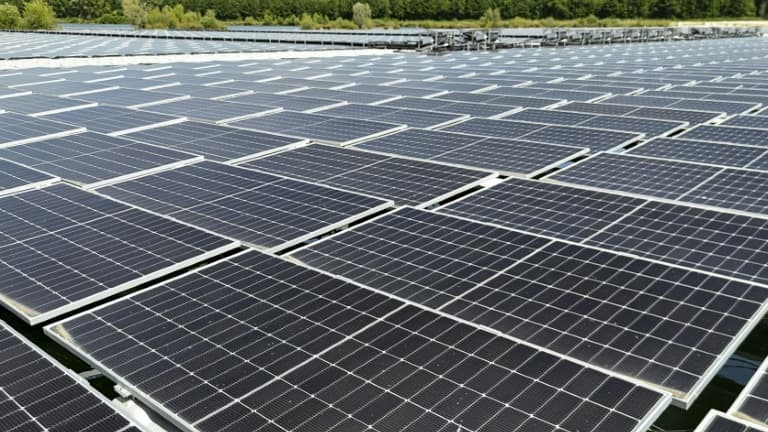
Too many renewable in France? The country “throws” more and more electricity that is not consumed or lower prices
10% of the solar energy produced in 2025 was not consumed. Error of production peaks to which the network and manufacturers must adapt.
This number was multiplied by two in one year: according to the RTE electrical network administrator, France died 2 TWH (terawattheures) renewable electricity in the first half of 2025, against 1.1 TWh in 2024.
In detail, France has triggered almost 0.8 TWh wind production (in 2024 it was 0.7 TWh) and 1.2 TWh of solar energy, the amount multiplied by three compared to the first six months of 2024. France produced 273.4 TWh electricity (all energy sources together).
The leading mechanism is quite simple: renewable energy has intermittent production – unstable equal amount of energy stable. During favorable climatic events (no more wind, more sun) can provide too much energy and appear excess that we decide to lose – it is “sharp”.
This for several reasons: untreated or partial connection to the network of production equipment or already saturated cables and links; Or even the production of such a amount of energy that it cannot be compensated – by storing electricity or in particular by reducing the production of pilotable energies (of which the production can be adjusted) such as hydroelectric and nuclear.
Growth crisis
Renewable sources are also victims of growth crisis: 2.1 GW (GIGAWATTS) of sun capacity and 0.2 GW wind capacity (ground and sea) installed from January to May by the end of May 2025 to 26.4 GW for solar energy and 24.6 for wind turbines. Compared to the previous year, a solar energy production jumped 3.5 TWh; In June Solar, France, even crossed the nuclear. This mechanically increases the risks of surplus and therefore recorded losses. RTE emphasizes that the numbers explode for solar energy.
“On average between April and June, the trimmed production corresponds to approximately 10 % of the volume theoretically produced for solar energy (compared to 5 % in 2024 and 1 % in 2023),” the network administrator explains.
Although exports to foreign countries are growing (37.6 TWhs were exported by France in the first 6 months or approximately 13%), this phenomenon should not be weakened. Jean-Paul Harreman, Director of the Cabinet Montel Analytics, explains that the worst thing is to come this summer.
“Negative electricity prices should reach record levels in some European regions in the third quarter. This trend is supported by continuous expansion of renewable capacities, especially solar energy, without an equal increase in basic demand.”
This increase should also continue because of the difficulties that are experienced by nuclear sectors – waiting for the new generation reactors, EDF faced corrosion – and hydroelectric problems with recurring drought.
Negative prices and no demand
The main consequence of this increase in the level of renewable sources is price change: at the tops of production, prices may be negative, industrialists prefer to sell for loss rather than extinguish their production sites, to restart for a long time. This was the case of 363 hours in France, again a record, although it is smaller than in Spain (459 hours) or Sweden (506 hours), two countries with ambitious renewable strategies. On the contrary, in the evening, prices are rising because renewable production leaves space for fossil power plants.
Paradox increased by RTE: Despite the increase in waste and the increase in negative prices, the price of average electricity will not decrease. During the first six months of 2025, it even increases to EUR 67/MWh. This overlaps Irena’s numbers, the international renewable sources agencies: 91% of the new renewable capacities installed in 2024 provided cheaper electricity than their fossil counterparts.
For the energy of consumers of manufacturers, variations can be complicated for management. Also important are the consequences for the network, regularly for voltage. As far as consumers are concerned, the main consequence may be to withdraw the price of the purchase for homes that produce their electrons: it is more cohesive to self -government. In terms of invoices, no immediate impact: This energy in negative soil is consumed by companies. And penalized electricity manufacturers are compensated by a state that can become public finance and have a negative impact on invoices eventually (On the contrary, contracts stipulate that manufacturers are part of their profits when prices are very high).
Invest massively in a better control of peaks
In electricity manufacturers, negative prices are problematic because they limit profits and above all threaten installations. In the case of a negative price, they often prefer to sell but can stop production; For example, the possibility of an explored Spaniard Iberdrola, for example at his fleet of wind turbines outside Saint-Brieuc (Côtes d’Arnor). Turbines are stopped for a moment but this Stop & go would damage them to long -term terms.
Another problem appears on the EDF side: when the peaks of renewable sources occur, nuclear power plants must be located partially at rest and not created. Of course, these power plants cannot be stopped, even less for a few hours each day; EDF therefore has the costs that remain the same, without production related to it.
The solution to compensate for these peaks, which therefore do not export the net and its actors, are multiple. First, stimulate electricity consumption at a time outside the bake – especially in the afternoon in the summer, in the middle of the solar peak. This includes reworking prices offered to EDF consumers. The installation of charging stations for electric vehicles, widespread in the United States or Germany, could support recharge within the leadership and provide network support.
In particular, RTE plans to invest EUR 100 billion to adapt the infrastructure to the solar hatchery. The aim of this plan is to strengthen, develop storage and modernize the network to make it possible to better support variations. ENEDIS must manage a million manufacturing points to be connected.
Without these fittings, it remains to tolerate losses generated peaks: “You can let your net absorb every kilowat hour produced. Or otherwise, because the wind or sun does not generate any marginal costs, tolerates a little if you finally create it,” explains, for example, a special brand that occurs, Aurora, Aurora.